Booth Upholstery and Fire Code: CAL TB 117-2013, Double Rubs and Commercial Vinyl
How to specify restaurant booth upholstery in the US: CAL TB 117-2013, double-rub abrasion ratings, vinyl vs. fabric vs. leather, foam and cleaning codes.
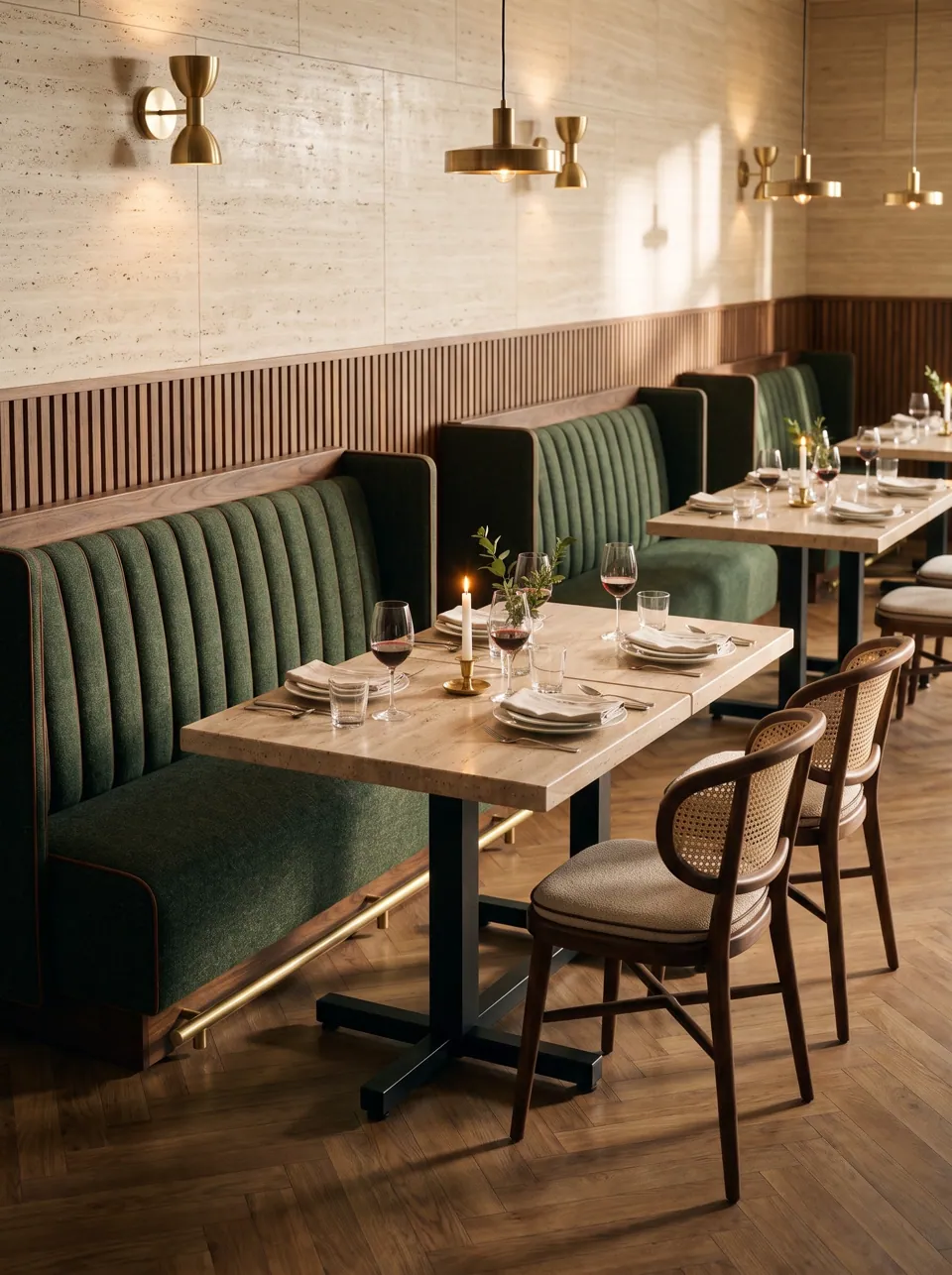
Short answer: For restaurant booths in the US, specify a cover material rated at least 30,000 double rubs (Wyzenbeek, ASTM D4157) for heavy-duty contract use, with a cleaning code that suits your service, over firm high-resilience foam. For flammability, CAL TB 117-2013 is the common baseline for the cover, barrier and filling materials, but the requirement for your room is set by your state and local fire authority, so confirm it before ordering.
Upholstery is where booths win or lose. Frames rarely fail; seat fronts wear through, seams split and fabrics stain. This guide covers what to ask for, and how to read the specifications suppliers give you.
What fire standards apply to restaurant booths?
There is no single national rule that covers every restaurant booth in every state. Instead, several standards are commonly referenced, and your local fire marshal decides which apply to your occupancy.
| Standard | What it tests | Where you see it |
|---|---|---|
| CAL TB 117-2013 | Smolder (cigarette) resistance of cover fabrics, barriers and filling materials | California; widely used as a baseline by specifiers nationally |
| 16 CFR Part 1640 | Federal adoption of the TB 117-2013 smolder standard for upholstered furniture (2021) | Upholstered furniture sold in the US, aimed primarily at residential products |
| NFPA 260 / ASTM E1353 | Cigarette ignition resistance of upholstered furniture components | Some contract and institutional specifications |
| NFPA 261 / ASTM E1352 | Cigarette ignition of a mock-up assembly | Some contract specifications |
| CAL TB 133 | Full-scale open-flame test of seating | Older public-occupancy specifications; check whether your authority still references it |
Restaurants are generally classified as assembly occupancies once they reach an occupant load of 50 or more under NFPA 101 and the International Building Code, which brings additional scrutiny of interior finishes and furnishings in some jurisdictions. Fixed upholstered wall panels behind booths can also be treated as interior finish rather than furniture, which has its own rules.
What we do: at Banquette House (a line by EASEN Commercial Furniture) we specify foams and cover materials to meet CAL TB 117-2013 on request, and supply test reports for the specific item where available. If your authority requires a different test, tell us at the quote stage and we will source materials to that specification.
What does a double-rub rating mean?
A double rub is one forward-and-back pass of an abrasive across the fabric in a standardized test. The higher the number before visible wear, the more durable the fabric. Two methods are used:
- Wyzenbeek (ASTM D4157): the common method in North America, reported in double rubs.
- Martindale (ASTM D4966 / ISO 12947): the common method in Europe, reported in cycles. The two numbers are not directly convertible.
The Association for Contract Textiles (ACT) publishes widely used performance guidelines:
| Use | Wyzenbeek | Martindale |
|---|---|---|
| General contract upholstery | 15,000 double rubs | 20,000 cycles |
| Heavy-duty upholstery | 30,000 double rubs | 40,000 cycles |
For booth seats in a busy restaurant, treat heavy duty as the minimum. Many commercial vinyls are rated well above it. Backs see less abrasion than seats, which is why some operators use a velvet or decorative fabric on the back and a harder-wearing material on the seat.
Abrasion is not the only number. Also ask for seam slippage, pilling, colorfastness to light and crocking (color rub-off), and, for vinyl, cold crack and hydrolysis resistance.
Vinyl, fabric or leather for restaurant booths?
| Material | Strengths | Watch out for | Best for |
|---|---|---|---|
| Commercial vinyl | Wipe-clean, high abrasion ratings, large color range, consistent | Can feel warm; low grades crack or peel; check hydrolysis rating | Family dining, diners, high volume |
| Woven contract fabric | Warm, textured, wide design range | Stains if untreated; check cleaning code | Upscale casual, hotel dining |
| Velvet (contract grade) | Rich color and depth | Pile crushing; choose high-rub contract velvet | Booth backs, bars and lounges |
| Leather | Ages well, premium feel | Cost, conditioning, variation between hides | Steakhouses, bars, private dining |
For vinyl, ask whether the material meets the Chemical Fabrics and Film Association guideline for vinyl upholstery (CFFA-W-101-D) or an equivalent. It is a useful shorthand for contract-grade performance.
Cleaning codes
Fabrics carry a cleaning code that tells your staff what they can use:
- W: water-based cleaners.
- S: solvent-based cleaners only.
- W/S: either.
- X: vacuum or brush only, no liquids. Not suitable for restaurant seats.
Pick W or W/S materials for booth seats, and check that the material tolerates the disinfectant you actually use.
What foam should a commercial booth use?
Commercial booth seats need firmer, more resilient foam than residential sofas, because they are sat on for many hours a day and must recover quickly. Ask for the foam type, density and firmness for the seat and the back separately.
Good practice for booth seats:
- High-resilience (HR) foam for the seat, over a firm base layer or deck, so the cushion does not bottom out at the front edge.
- A firmer front edge, where wear concentrates.
- A fiber or soft foam wrap for comfort, kept thin enough to avoid a saggy look.
- Backs slightly softer than seats.
- Foam and wrap specified to the fire requirement for your project.
How should booth upholstery be detailed for wear?
Material choice is half the story; how the booth is sewn and built decides where it wears. Four details make a measurable difference over the life of a booth:
- Seam placement. Keep seams off the front edge of the seat, where every guest slides in. A seat made from one panel wrapped over the front lasts longer than one with a welt along the edge.
- Removable seat cushions. A seat that lifts out, or is fixed with concealed fasteners, can be re-covered off site in hours instead of re-upholstering the whole run in place.
- Protected ends. Booth ends at an aisle are hit by chairs, bags and cleaning carts. Timber, laminate or metal end panels survive far better than upholstered ends.
- Recessed plinths. A base set back 2–3 in from the seat front keeps shoes and mops off the fabric.
Steps to specify booth upholstery
- Confirm the fire requirement with your local fire marshal or code consultant before choosing materials.
- Choose the material type for seats and backs separately.
- Set minimum performance: at least 30,000 double rubs (Wyzenbeek) or 40,000 cycles (Martindale) for seats, W or W/S cleaning code, and the relevant fire test.
- Request the data sheet and, where needed, test reports for the specific material.
- Decide COM or supplier material. If COM, send width, repeat and roll quantity so yardage can be calculated per section.
- Approve a sample of the material on a small upholstered panel, or a full pre-production section for larger orders.
- Write the care routine for staff before opening day.
Common mistakes
- Choosing a residential fabric because it looks right. Residential fabrics often fail within months on booth seats.
- Specifying by appearance, not by data sheet. Two vinyls can look identical and perform very differently.
- Assuming one fire label covers everything. The cover, barrier and filling may each need to meet the requirement.
- Forgetting cleaning chemistry. Strong disinfectants can damage some vinyls and finishes; check compatibility.
- Soft foam at the seat front. It looks plump in photos and collapses quickly in service.
- Leaving fire documentation until inspection. Ask for documentation when you order.
Where to see it in our range
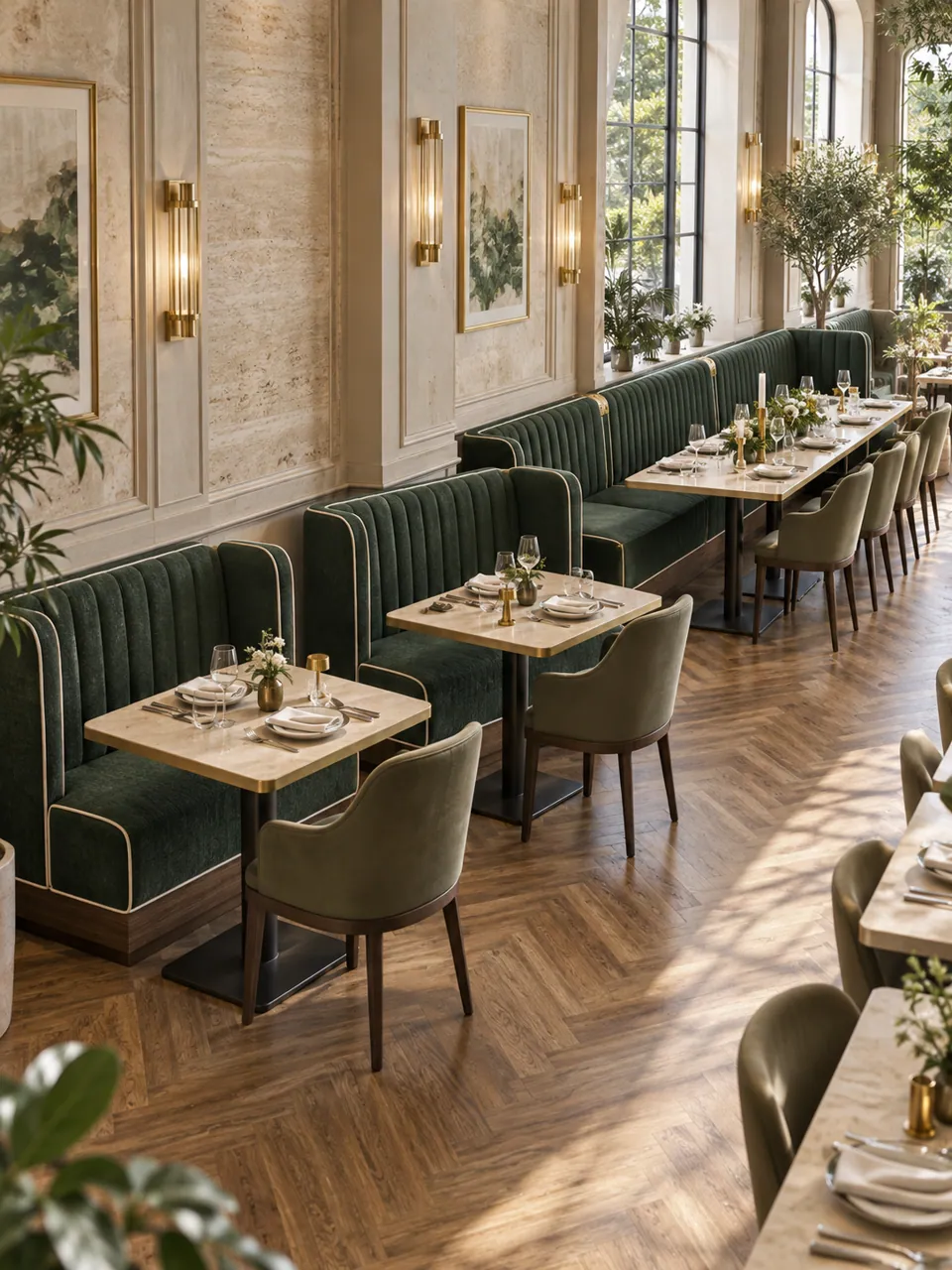
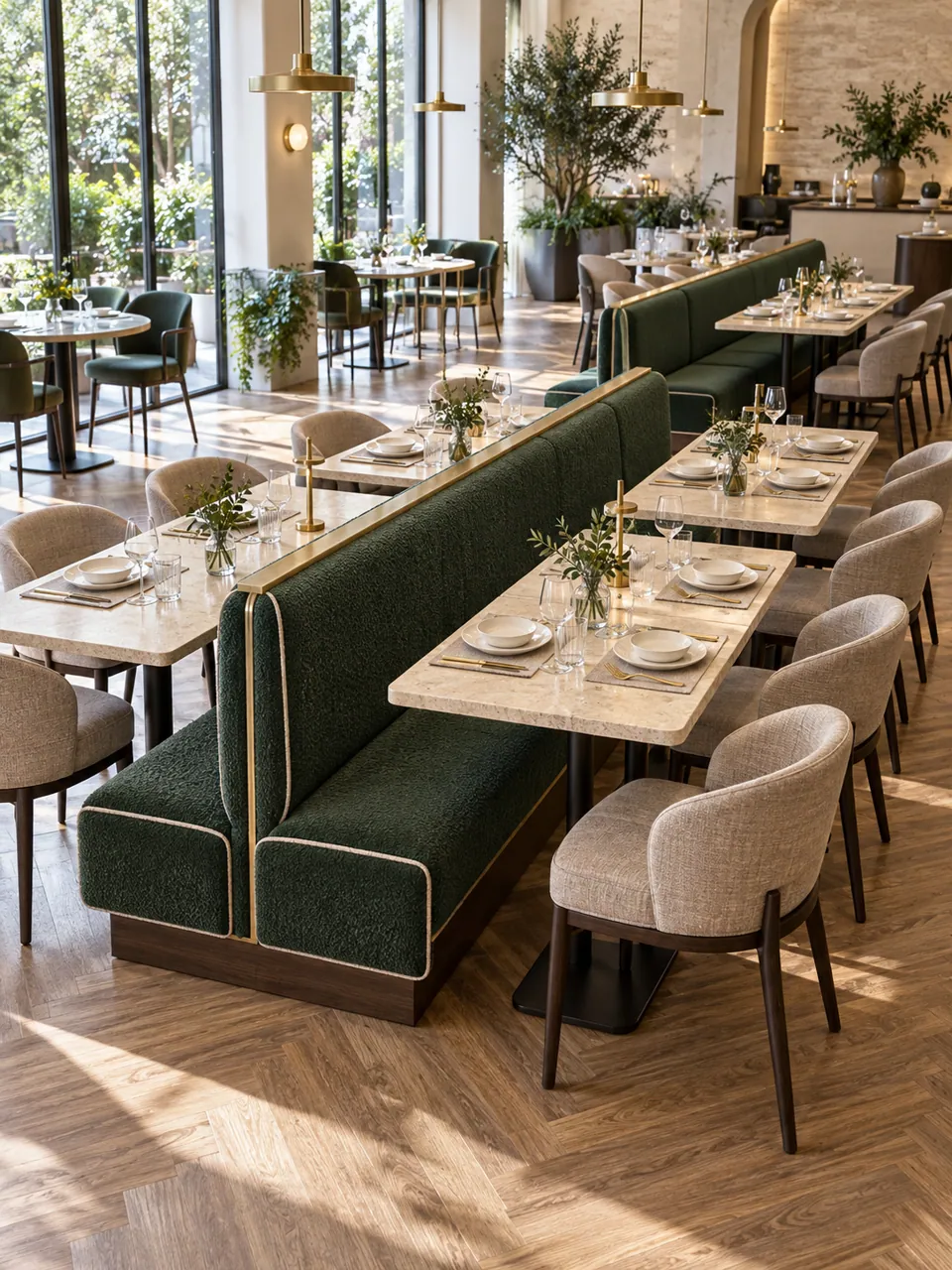
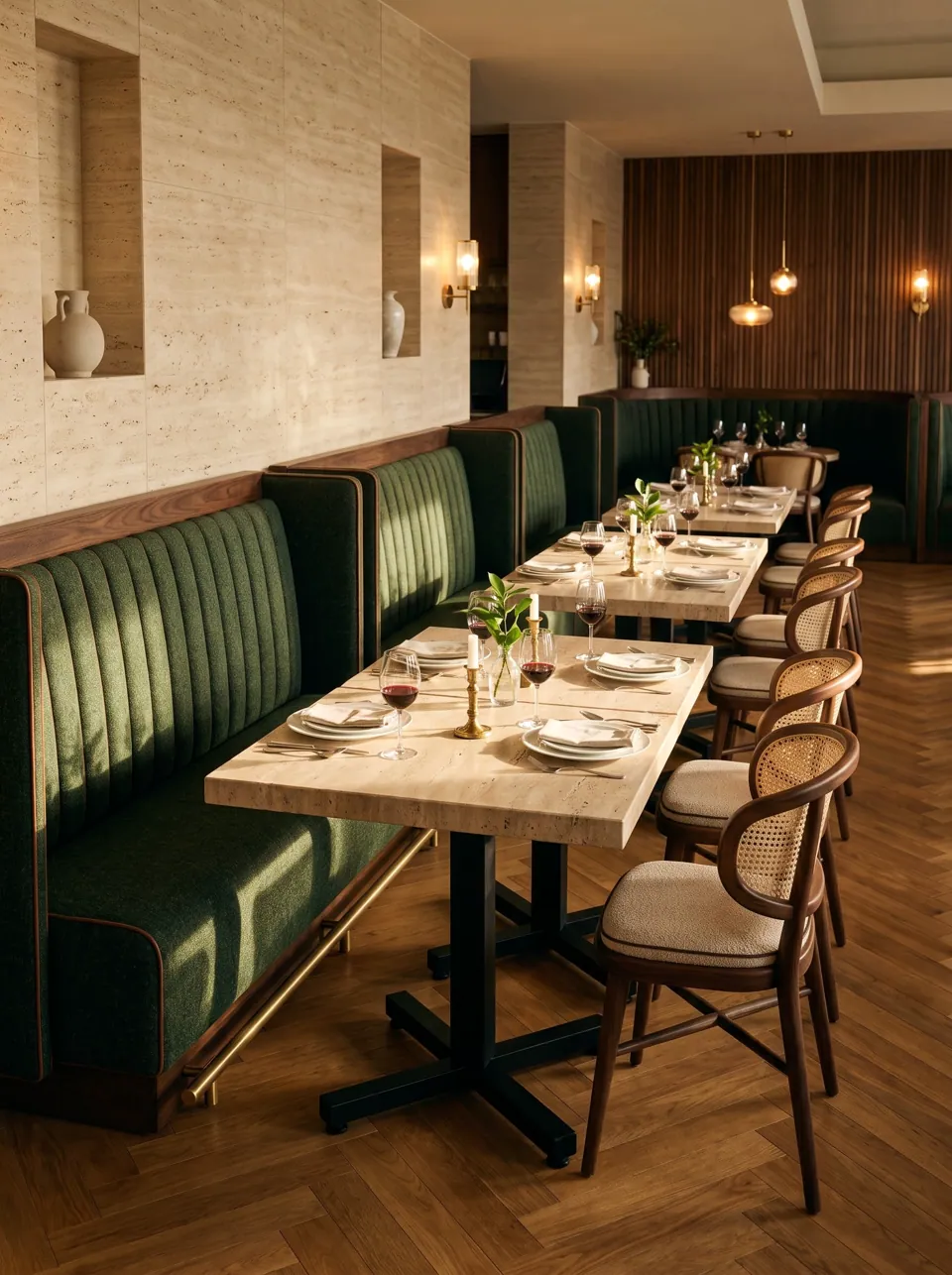
Our Bowery Biscuit-Tufted Banquette uses buttonless tufting so there are no button holes to trap dirt, and the Gramercy Velvet Half-Round Booth shows how a velvet back can be paired with a tougher seat. All pieces in our Wall Banquettes collection can be built in your own COM or COL material.
FAQ
Do restaurant booths have to meet CAL TB 117-2013?
It depends on your state and local authority. TB 117-2013 is the common baseline and is required for upholstered furniture sold in California; your local fire marshal decides what applies to your restaurant. We specify materials to meet it on request.
How many double rubs does a restaurant booth fabric need?
At least 30,000 double rubs on the Wyzenbeek test (heavy-duty contract, per ACT guidelines), or 40,000 Martindale cycles. Many commercial vinyls exceed this.
Is vinyl or fabric better for restaurant booths?
Vinyl is easier to clean and generally more durable on seats; fabric and velvet feel warmer and suit backs and upscale rooms. Many restaurants combine them.
Can I supply my own fabric?
Yes. Send us the material details and we calculate yardage from the shop drawing. Choose a material rated for heavy-duty contract use and confirm its fire documentation with your supplier.
How long does booth upholstery last?
It depends on the material, foam, traffic and cleaning. Contract-grade materials over firm foam last far longer than residential materials. Seat fronts wear first; designs with replaceable seat cushions make refurbishment simpler.
Send us your floor plan or wall dimensions and the number of covers you need. We will reply with a layout suggestion and a quote by the linear foot.
Request a quote