Shipping Restaurant Booths from China to the US: Lead Time, Packing and Delivery (2026)
How custom restaurant booths travel from Foshan to your dining room: lead times, knock-down vs assembled sections, FOB, CIF or DDP, LCL vs FCL and US customs.
Short answer: Custom restaurant booths ordered from our factory in Foshan typically take 30-45 days to build for standard designs and 45-60 days for custom work, counted from approved shop drawings and sample, plus ocean transit and US customs clearance. Booths travel as upholstered sections sized to your doors, wrapped and crated for a sea container, and are quoted FOB, CIF or DDP depending on how much of the import you want to handle yourself. Plan the whole chain backwards from your opening date, not forwards from the day you place the order.
Banquette House (a line by EASEN Commercial Furniture) builds booths and banquettes to your floor plan in our own production base in Lecong, Foshan, and ships them direct. This guide walks through what happens between "drawings approved" and "guests seated", and where the time really goes.
Where does the time go between order and install?
Most owners underestimate the front and back ends of the schedule and overestimate the factory part. The sequence looks like this:
| Stage | What happens | Who drives it |
|---|---|---|
| Brief and measurements | Floor plan, wall lengths, outlets, door widths, photos | You and your designer or GC |
| Shop drawings | Dimensioned drawings of every run, section split and fabric | Us, then your approval |
| Sample (optional) | A seat-and-back sample or a fabric/foam swatch set | Us, then your sign-off |
| Production | Frames, foam, upholstery, finishing, quality check | Us: about 30-45 days for a standard booth, 45-60 for a custom one |
| Inspection and packing | Photos/video of finished sections, export packing | Us, with your approval |
| Ocean freight | Port of loading in South China to a US port | Forwarder (yours or ours) |
| Customs and delivery | Entry, duties, drayage, final delivery to site | Customs broker and trucker |
| Install | Positioning, joining sections, fixing to wall or floor | Your installer or GC |
The production window only starts once drawings are approved and, if you asked for one, the sample is signed off. Drawing revisions are the most common reason a booth order slips, so collect your comments in one round rather than three.
Exact lead times are confirmed in each quote, because they depend on the design, the upholstery and how busy the sewing floor is.
How are booths built to ship? Knock-down vs assembled sections
A booth is bulky and mostly air, so packing strategy decides both freight cost and how easily it gets into your building.
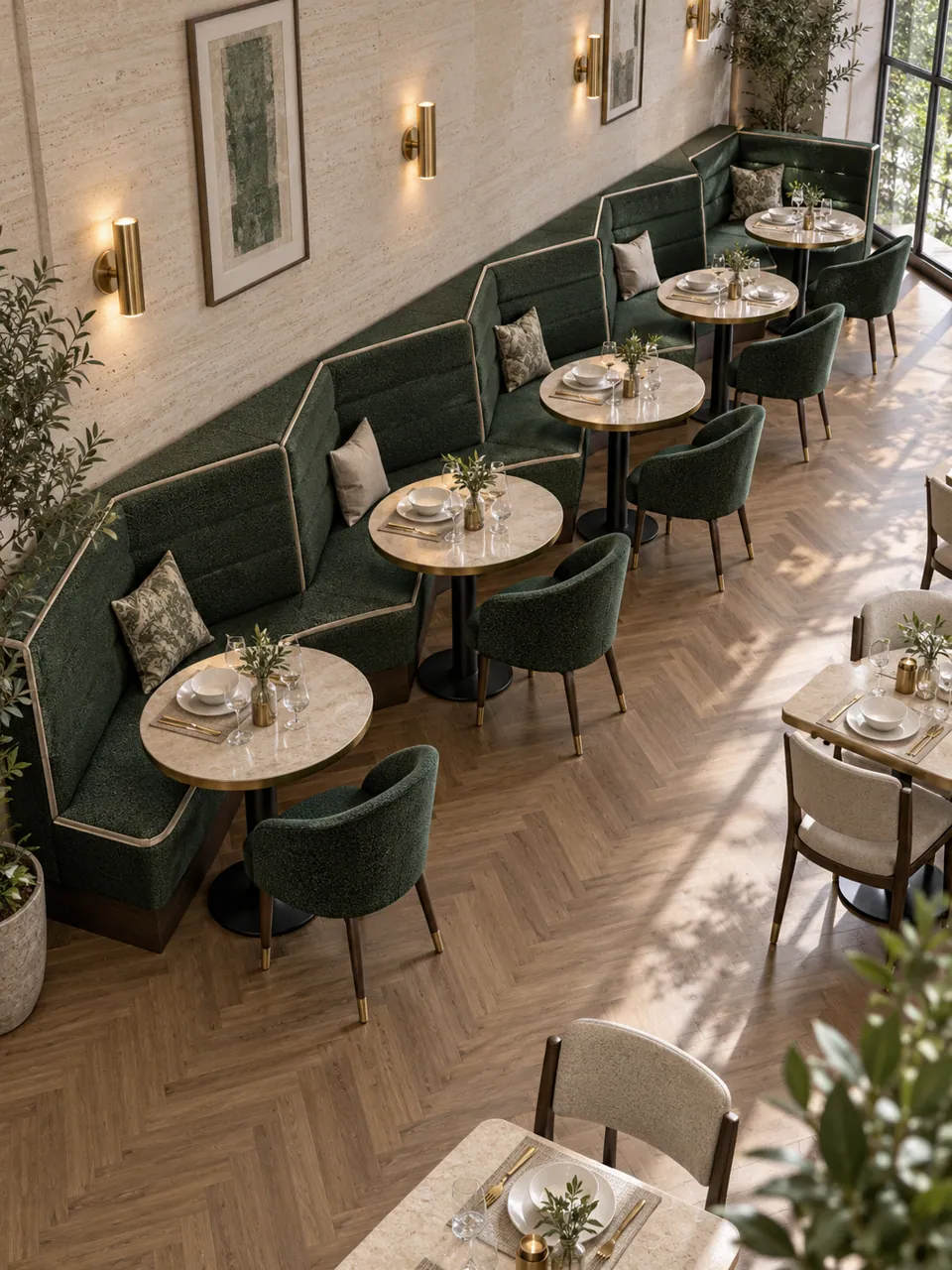
Assembled upholstered sections. Most wall banquettes and booths ship as finished seat-and-back units, split into sections that will pass through your door, stairwell and any tight corridor. Long runs such as the Lexington Continuous-Run Banquette are divided at seams that are planned on the shop drawing, so the joint lines up with channels or panels rather than landing mid-pattern.
Knock-down (KD) components. Where the design allows, backs can be detached from seat boxes, legs removed, and end panels packed flat. KD packing lowers the volume per linear foot, which matters if you are paying for freight by volume. It does mean a little more work on site, usually bolting backs to seats with the hardware we supply and label.
Curved and island pieces. Half-round and U-shaped booths are split into segments that follow the radius. Our Curved, Half-Round & U-Shaped Booths are drawn with these splits in mind, so a big horseshoe arrives as manageable pieces that bolt back into one continuous curve.
| Packing format | Freight volume | Site work | Best for |
|---|---|---|---|
| Fully assembled sections | Highest | Minimal: place, join, fix | Short runs, simple doors |
| Back detached from seat | Medium | Bolt backs on | Most booth packages |
| Full KD (backs, seats, ends, legs) | Lowest | More assembly | Large packages, tight access |
| Segmented curves | Medium to high | Join segments to the radius | Half-round, U and serpentine booths |
Tell us your door clear opening, any stairs or elevators, and the route from the curb to the dining room. That information sets the maximum section length on the drawing.
What does export packing look like?
Every section is protected for a long sea voyage and several handlings:
- Upholstery wrapped in a clean film to keep out dust and moisture.
- Foam or cardboard corner and edge guards on frames, legs and any timber or metal trim.
- Heavy cartons, with wooden crating or frames for long, curved or heavy pieces.
- Hardware bagged and labeled by section, with an assembly sheet.
- Every carton marked with the run number from the shop drawing, so installers know where each piece goes.
Any solid-wood crating or pallets we use for export are ISPM 15 heat-treated and marked, which US Customs and Border Protection requires for wood packaging material.
Which shipping terms should a restaurant choose: FOB, CIF or DDP?
We quote three common Incoterms on request:
| Term | We handle | You handle | Good fit when |
|---|---|---|---|
| FOB (China port) | Packing, export clearance, loading | Ocean freight, insurance, US customs, duties, delivery | You or your GC already use a freight forwarder |
| CIF (US port) | FOB plus ocean freight and insurance to the US port | Customs entry, duties, port charges, delivery | You want a simple ocean price and your own broker |
| DDP (your site) | Door-to-door, including clearance and duties | Unloading and installation | You want one landed number and minimal admin |
FOB gives you the most control and visibility. DDP gives you the simplest paperwork. CIF sits in between, but note that destination port and terminal charges are usually still yours.
LCL or FCL: do booths fill a container?
LCL (less than container load) means your booths share a container with other shippers' cargo. It suits a small order, a single feature booth or a top-up. It involves more handling at consolidation and deconsolidation warehouses, so packing matters more.
FCL (full container load) means a container dedicated to your order: a 20ft, 40ft or 40ft high cube. A full dining room of booths, plus tables and chairs, often fits an FCL, and booths are volume-heavy rather than weight-heavy, so the high cube is a common choice. Mixed loads are welcome: booths, chairs and table bases from the same factory can share one container. We send a packing list with carton sizes and volumes before booking so you can see the fill.
What happens at US customs?
You (or the DDP provider) act as importer of record. In practice a licensed customs broker does the work:
- ISF (Importer Security Filing) must be lodged before the container is loaded in China. Your broker or forwarder files it using details from our commercial invoice and packing list.
- Entry and duties. Upholstered seating is classified under the furniture chapter of the Harmonized Tariff Schedule. Booths made in China also carry additional Section 301 tariffs on top of regular duty, and their scope has shifted several times; your broker confirms the current treatment before you budget.
- Customs bond. A continuous or single-entry bond is needed for formal entries.
- Documents we supply: commercial invoice, packing list, bill of lading, and on request material descriptions and any test reports available for fire-related specifications.
This is general information, not customs advice. Your broker is the authority for your shipment.
West Coast or East Coast port?
From South China, the shortest ocean leg lands on the West Coast; East Coast and Gulf ports involve longer routings. The right choice depends on where your restaurant is: sometimes a West Coast arrival plus rail or truck is faster than a direct East Coast sailing, sometimes not. Ask your forwarder to compare door-to-door options for your ZIP code rather than port-to-port.
Payment and inspection before shipment
The usual flow is a deposit to start production, then the balance before shipment. Before you pay the balance, we send photos and video of your finished booths and packing so you can check sizes, fabric and stitching. You are welcome to hire a third-party inspection company to visit the factory at that stage.
Planning steps for an on-time opening
- Lock your floor plan and measure the actual walls, not just the architectural drawings.
- Record door widths, stairs, elevators and the delivery route.
- Choose fabric or vinyl early; if supplying COM, ship it to the factory promptly.
- Approve shop drawings in one consolidated round.
- Approve the sample, if ordered.
- Agree Incoterms and appoint a customs broker before production finishes.
- Book freight once the inspection photos are approved.
- Arrange receiving: a dock, liftgate truck or crew to unload by hand.
- Book installers for the day after delivery, not the day of.
Common mistakes that delay booth deliveries
- Measuring from plans, not walls. Built walls rarely match the drawing to the inch; a booth built to the plan may not fit.
- Forgetting the door. A 12 ft section is no use if the corridor turns a tight corner. Split lines belong on the shop drawing.
- Late fabric decisions. Upholstery cannot be cut until the material is on the floor.
- No ISF in time. A late filing can mean penalties and holds.
- Delivering to an unready site. Booths stored in a dusty site under construction get damaged. Schedule delivery after floors and paint are done.
- Ignoring Section 301 in the budget. Ask your broker before you compare quotes.
Explore the booths collection for formats that pack well into mixed containers.
FAQ
How long does it take to get custom restaurant booths from China?
Once drawings and samples are signed off, a standard booth design usually takes 30-45 days to build and a custom one 45-60 days. Add drawing time at the start, and ocean transit, customs clearance and delivery at the end. Your quote confirms the timeline for your design.
Do booths arrive assembled?
Usually as upholstered sections sized to pass through your doors, with backs sometimes detached to save volume. Hardware and an assembly sheet are labeled by section.
Can you ship a small booth order?
Yes. Smaller orders typically go LCL in a shared container. Larger packages usually justify a full container, which can mix booths with chairs and tables.
Who handles US customs?
Under FOB or CIF, your customs broker files the ISF and entry and you pay duties. Under DDP, the landed price includes clearance and duties to your site.
Send us your floor plan or wall dimensions and the number of covers you need. We will reply with a layout suggestion and a quote by the linear foot.
Request a quote